The idea of market timing is deeply appealing. Buy at the bottom, sell at the top, and repeat the process to accelerate wealth creation. In theory, it sounds simple. In reality, market timing is one of the most commonóand most damagingómistakes investors make.
Across decades of market history, evidence consistently shows that attempting to predict short-term market movements often leads to missed opportunities, increased stress, and weaker long-term results. Even experienced professionals struggle to time markets consistently. For individuals, entrepreneurs, and CEOs whose primary focus lies outside daily market fluctuations, market timing can quietly undermine financial success.
This article explores why market timing is dangerous, how it affects investor behavior, and why a disciplined, long-term approach is far more effective for building sustainable wealth.
What Is Market Timing?
Market timing is the practice of moving money in and out of financial markets based on predictions about future price movements. Investors attempt to anticipate short-term highs and lows by reacting to economic data, news events, technical indicators, or sentiment shifts.
Market timing can take many forms:
Selling investments in anticipation of a market decline n- Waiting on the sidelines for the ìright momentî to invest
Increasing exposure after markets have already risen
Attempting to avoid volatility through frequent trades
While the goal is to reduce risk or enhance returns, the outcome is often the opposite.
Why Market Timing Is So Tempting
Human psychology plays a central role in the appeal of market timing.
Investors are naturally loss-averse. The fear of seeing portfolio values decline can feel more painful than the satisfaction of gains. News headlines amplify this fear, especially during periods of economic uncertainty or market volatility.
At the same time, greed and overconfidence emerge during bull markets. Rising prices create the illusion of predictability and control.
These emotional forces encourage reactive decisionsóbuying when confidence is high and selling when fear dominates. Unfortunately, this behavior tends to occur at precisely the wrong times.
The Illusion of Control
Market timing creates the illusion that investors can control outcomes in an inherently uncertain environment.
Financial markets are influenced by countless variables: economic data, interest rates, geopolitical events, technological change, and human behavior. Many of these factors are unpredictable and often priced into markets before individuals can react.
Believing that one can consistently outguess millions of participantsóincluding institutions, algorithms, and professional managersóis unrealistic. The illusion of control often leads to excessive trading and misplaced confidence.
Missing the Best Days
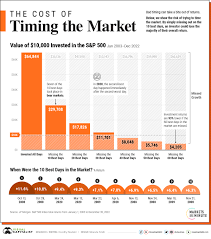
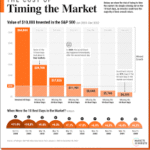
One of the most damaging consequences of market timing is missing the marketís best days.
Historical data consistently shows that a small number of strong market days account for a significant portion of long-term returns. Investors who move in and out of the market risk being absent during these critical periods.
Because the best days often occur during volatile or uncertain times, investors waiting for ìclarityî frequently re-enter the market too late.
Time in the market matters far more than timing the market.
Compounding Disrupted
Compounding is the engine of long-term wealth creation. It requires consistency, patience, and uninterrupted exposure to growth assets.
Market timing interrupts compounding by introducing gapsóperiods when capital is not invested. Even short interruptions can have outsized effects over time.
By contrast, disciplined investors who remain invested allow returns to build upon themselves year after year. The difference between these approaches becomes dramatic over long horizons.
Costs, Taxes, and Friction
Frequent buying and selling creates friction.
Market timing increases:
Transaction costs
Tax liabilities
Bid-ask spreads
Opportunity costs
These frictions may seem small individually, but they compound negatively over time. Long-term investors benefit not only from growth, but also from efficiency.
Reducing unnecessary activity often improves outcomes.
Emotional Decision-Making
Market timing is rarely a purely analytical exercise. It is driven by emotion.
Fear leads to selling during downturns. Greed leads to buying after prices rise. Regret leads to hesitation and inconsistency.
Once emotions dominate decision-making, discipline erodes. Investors abandon long-term plans in favor of short-term reactions.
Successful financial strategies minimize emotional interference through structure and process.
Why Even Professionals Struggle
If market timing were reliably effective, professional investors would consistently outperform markets. Yet evidence shows that even active fund managers struggle to time markets successfully.
Professional managers face constraints such as:
Career risk
Client expectations
Regulatory requirements
Market competition
For individuals without institutional resources, the challenge is even greater.
Market Timing vs Strategic Allocation
Market timing should not be confused with strategic asset allocation.
Strategic allocation involves setting long-term exposure based on goals, time horizon, and risk tolerance. It may include periodic rebalancing to maintain intended risk levels.
This approach differs fundamentally from attempting to predict short-term market movements. Strategic allocation is proactive and disciplined; market timing is reactive and speculative.
Volatility Is Not Risk
Many investors equate volatility with risk. This misconception fuels market timing behavior.
Volatility is a natural feature of markets. It represents short-term price movement, not permanent loss.
True risk lies in failing to meet long-term objectives due to poor decisions, lack of diversification, or emotional reactions.
Avoiding volatility often means avoiding growth.
The CEO Perspective: Focus and Delegation
CEOs and business leaders understand the value of focus.
Attempting to time markets diverts attention from core responsibilitiesóbuilding companies, leading teams, and making strategic decisions.
A structured investment approachówhether through diversified portfolios or managed fundsóaligns better with executive thinking. Objectives are set, systems are implemented, and outcomes are reviewed periodically.
This mirrors effective business governance.
A Better Alternative: Discipline and Consistency
Rather than timing markets, successful investors focus on:
Long-term asset allocation
Regular investing
Diversification
Cost efficiency
Periodic review
This approach accepts uncertainty but manages it intelligently.
Consistency replaces prediction.
Dollar-Cost Averaging
Dollar-cost averaging is one method that reduces the temptation to time markets.
By investing fixed amounts at regular intervals, investors smooth entry points and reduce emotional stress. This approach works particularly well for long-term goals.
It transforms volatility from a threat into a neutralóor even beneficialófactor.
Learning from Market History
Every major market decline has been followed by recovery over time. Investors who exited markets during crises often struggled to re-enter.
History teaches a simple lesson: markets reward patience, not prediction.
Those who remain invested through cycles benefit from resilience and growth.
Common Market Timing Traps
Investors frequently fall into predictable traps:
Waiting for certainty that never arrives
Selling after significant declines
Chasing short-term trends
Overreacting to headlines
Awareness of these traps is the first step toward avoiding them.
Aligning Strategy with Goals
Investment strategies should serve goalsónot emotions.
Clear objectives, time horizons, and risk tolerance provide a framework for decision-making. When markets fluctuate, this framework provides stability.
Without it, market noise dominates.
Final Thoughts
Market timing is seductive, but dangerous.
It promises control in an uncontrollable environment and often delivers the opposite of its intent. Lost time, missed opportunities, and emotional stress are common outcomes.
Long-term financial success is built on discipline, diversification, and patienceónot prediction.
For investors focused on sustainable wealth creation, avoiding market timing is not a passive choice. It is a strategic decisionóone that protects compounding, preserves focus, and supports lasting financial success.
Summary:
Market timing are the two most dangerous words in investing – especially when practiced by novice traders.
Market timing is the strategy of attempting to predict future price movements through use of various fundamental and technical analysis tools – and when used to predict trending moves, ends in disaster, and losses.
Keywords:
market timing
Article Body:
Market timing are the two most dangerous words in investing – especially when practiced by novice traders.
Market timing is the strategy of attempting to predict future price movements through use of various fundamental and technical analysis tools – and when used to predict trending moves, ends in disaster, and losses.
Many investors feel that market timing is the same as trend following and the two go hand in hand, they donít.
Trend Following and Market Timing
Trend Followers REACT to market movement and act on these moves when they occur.
Traders who believe in Market Timing think they can PREDICT turning points in advance and buy at a low or sell at a high.
This is impossible to do; no one can predict the market.
Market timing advocates ìbuy low and sell highî but this is not the way to make money from trend following.
The Real aim of Trend Following
To increase your chances of success in trend following you need to wait for confirmation of a move and for a trend to develop.
You are going to miss the start of the trend and not buy the bottom or sell the top, but this is hindsight.
By waiting for the confirmation for the trend to develop, the probability of the trend continuing and you getting a proportion of the profits are vastly increased.
The real way to make money donít predict wait for confirmation!
The real way to make money is by ìbuying high and selling higherî and ìselling low and buying lowerî You will have far less losses this way and still make healthy profits than if you try to predict with market timing techniques.
Market timing is doomed to failure – as the market never does exactly what we expect, and no scientific law governs the market (despite what the followers of predictive theories such as Gann and Elliott wave might tell you).
We are only dealing with probabilities – not certainties.
Trading is an odds game and your entry and exit levels from the market need to reflect this.
This means trading only when the trend is underway and likely to continue.
Dealing with Volatility
When dealing with market timing many traders are attracted to it as they feel it controls risk.
One of the major problems for traders is when they enter a trend in motion and they get stopped out.
The most effective way of entering a trend is a breakout method, but very often the trade dips back stops out the trader and then goes back they way they thought, but there is a solution:
Enter the Trade with Options
Options give you staying power to ride out short-term pullbacks against you, but you need to know how to use them correctly and this means:
1. Buying in the money or close to the money options 2. Make sure you have plenty of time value on your side
This will increase your chances of success dramatically; give you staying power, limited risk and unlimited gains!
The best Method, Market and Vehicle for Trading
The best method to get in on a trend is a breakout method (read our other articles for more information on why) the best vehicle to control and manage risk on entry is options.
Finally, the best markets with the best trends to lock into for profit are:
The global FOREX markets, all the major currencies offer great long-term trends, many of which last for years.
These trends last so long that you can forget trying to predict with market timing and just take a proportion of the trend, which will still give you big profits over the longer term.
As you can see market timing is misunderstood and has nothing to do with making money from trend following and actually creates risk, rather than reducing it.
Market Timing ñ A Danger to Your Financial SuccessIntroduction
•
Tinggalkan Balasan