Written in a CEO-friendly, reflective tone, as if typed by hand during long market hours.
Introduction: Closing the Loop on 2008
When we look back at 2008, it is impossible to separate the EUR/USD story from the broader financial shock that reshaped global markets. This final part of the series is not written as a textbook analysis. It is written the way many of us actually experienced that year: one decision at a time, one sleepless night at a time, with charts open and headlines flashing red.
Managed forex accounts were not just an investment vehicle in 2008. They were a test of discipline, trust, and risk management. The EUR/USD pair, often considered the most liquid and predictable currency pair in the world, proved that even the deepest markets can behave irrationally under stress.
This article completes the trilogy by focusing on practical lessons, strategic positioning, and what 2008 taught professional managers about protecting capital while navigating opportunity.
The EUR/USD Environment in 2008: Reality vs. Expectation
At the beginning of 2008, many CEOs, portfolio managers, and private investors believed that the worst of the U.S. subprime crisis was already priced in. The euro was strong, confidence in the European Central Bank appeared firm, and the dollar was widely viewed as structurally weak.
EUR/USD trading above 1.45 felt justified. Some forecasts even talked openly about 1.60 as a medium-term target. From a distance, the logic made sense: U.S. rate cuts, slowing growth, and massive liquidity injections.
But markets do not move in straight lines, and crises do not follow polite economic models.
As the year unfolded, it became clear that this was not just a U.S. housing problem. It was a global balance sheet problem. European banks were deeply exposed, leverage was everywhere, and trust between institutions was quietly evaporating.
For managed forex accounts, this meant one thing: assumptions had to be challenged daily.
Managed Forex Accounts Under Stress
In normal years, managed forex accounts focus on consistency. Risk is measured, drawdowns are controlled, and performance is built over months. In 2008, the definition of “normal” disappeared.
Volatility expanded beyond historical ranges. Stops that once felt conservative were suddenly too tight. Correlations that had held for years broke down in weeks.
The EUR/USD pair became a battlefield between:
Safe-haven flows into the U.S. dollar
Structural concerns about U.S. debt
Sudden fear surrounding European banks
Central bank interventions and unexpected policy shifts
Professional managers had to make fast decisions while maintaining a calm external posture. Clients wanted answers, but the truth was uncomfortable: no one had a perfect map.
The Turning Point: When the Dollar Fought Back
One of the defining moments of 2008 for EUR/USD was the realization that, in times of panic, liquidity matters more than theory. The U.S. dollar, despite its problems, remained the world’s reserve currency.
As Lehman Brothers collapsed and credit markets froze, capital rushed toward safety. Not growth, not yield—safety.
EUR/USD reversed sharply.
What had looked like a long-term uptrend suddenly became a violent correction. Levels that took months to build were erased in weeks. For managed accounts that stayed stubbornly bullish, the damage was severe.
For those who adapted, reduced exposure, and respected price action, survival was possible.
This was the year when flexibility outperformed conviction.
Risk Management: The Only Real Edge
If there is one lesson every CEO should take from managed forex performance in 2008, it is this: returns are optional, survival is not.
Many strategies that looked brilliant in backtests failed under live stress. What worked instead was boring, disciplined risk control:
Smaller position sizes
Wider but logical stop placements
Reduced leverage during high-impact news
Willingness to stay flat
EUR/USD did not reward overconfidence in 2008. It punished it.
Managed accounts that survived were often those that underperformed during the best months, but stayed alive during the worst ones.
Central Banks: Words, Actions, and Market Psychology
The Federal Reserve and the European Central Bank played a constant chess match throughout 2008. Rate cuts, emergency lending facilities, and coordinated actions became common.
For EUR/USD traders, this created a dangerous environment. Markets reacted not only to decisions, but to tone, phrasing, and perceived hesitation.
A single press conference could reverse a trend.
Managed forex accounts had to respect event risk. Holding large EUR/USD positions during major central bank announcements became a calculated gamble rather than a strategic position.
This period reinforced the importance of combining technical awareness with macro understanding—without marrying either one.
Client Communication During Crisis
From a CEO’s perspective, one of the hardest parts of managing forex accounts in 2008 was communication. Clients did not just want performance reports. They wanted reassurance.
The most successful managers were transparent. They did not promise certainty. They explained process.
They said things like:
“Volatility is elevated, and we are reducing risk.”
“Capital preservation is the priority this quarter.”
“We are trading less, not because we are afraid, but because conditions demand respect.”
This approach built long-term trust, even when short-term returns were disappointing.
EUR/USD Technical Structure: Lessons from the Charts
From a technical perspective, 2008 was a masterclass in trend exhaustion and reversal. Long-term support levels that had held for years failed decisively.
Key observations included:
False breakouts became common
Momentum indicators stayed oversold longer than expected
Trendlines lost relevance during panic phases
For managed forex accounts, this meant simplifying. Fewer indicators. More focus on price, structure, and volatility.
Sometimes the best trade was no trade.
The Human Factor
Behind every managed account is a human decision-maker. In 2008, psychology mattered more than strategy.
Fear, pride, and fatigue influenced outcomes as much as analysis.
The managers who lasted were not necessarily the smartest. They were the most emotionally controlled.
They accepted losses quickly. They avoided revenge trading. They respected uncertainty.
EUR/USD in 2008 did not reward ego.
What 2008 Changed Forever
After 2008, managed forex accounts were never the same. Risk disclosures became longer. Leverage limits tightened. Investors asked better questions.
EUR/USD itself changed character. Volatility regimes shifted. Central bank credibility became a tradable factor.
For CEOs evaluating managed forex strategies, this year became a reference point—a reminder of what can happen when markets stop behaving politely.
Strategic Takeaways for Managed Forex Accounts
Looking back, several principles stand out:
Liquidity rules in crisis
Risk management beats forecasting
Flexibility is a strength, not a weakness
Client trust is built in bad times
EUR/USD is not always “safe”
These lessons remain relevant today.
Final Thoughts: A CEO’s Reflection
This article is not meant to glorify 2008. It was a painful year for many professionals. But it was also a defining one.
Managed forex accounts that survived 2008 earned credibility that no marketing brochure could buy. They proved that discipline matters when theory fails.
The EUR/USD outlook in 2008 taught us humility. It reminded us that markets are bigger than models and faster than assumptions.
As CEOs, investors, and managers, the real value of studying this period is not prediction—it is preparation.
Because the next crisis will look different, but it will ask the same questions:
How do you manage risk?
How do you communicate uncertainty?
How do you stay rational when markets are not?
In the end, that is the real legacy of EUR/USD in 2008.
End of Part 3/3
Summary:
Forex Managed Accounts update: Where the EUR/USD is heading in 2008! Why the USD weakend in 2007, where US Economy is going and how the US presidential elections may affect the financial markets!
Keywords:
Forex Managed Accounts,forex,economy,
Article Body:
What the Eurozone Outlook May Be
The performance of the EUR/USD is heavily influenced by economic prospects in the Eurozone. Part of the reason the EUR/USD rose to its all-time high of 1.4968 was while the US Federal Reserve lowered rates by 100bp, the ECB raised its rates by 50bp. It was feared throughout 2007 that the strong euro would adversely impact the Eurozone economy. On the contrary, growth was buoyant, as Germany’s exports increased and boosted its trade surplus. Demand within the Eurozone was resilient and emerging markets spurred growth. Taking a cue from the lessons of 2004, when EUR/USD reached 1.36, Eurozone corporations were able to manage their foreign exchange risk much better in 2007 by increasing local production to minimise the effects of a weak US dollar.
Going forward into 2008, growth is finally starting to slow down. Business confidence in Germany slid to its lowest level in two years amid fears that higher interest, tightening credit, and rising inflation could adversely impact the economy. Both the European Commission and the ECB believe that 2008 growth will be less than initial estimates. The ECB has stopped making public statements about the Eurozone being immune to infection from the US business cycle; recent injections of liquidity into the financial system now prove otherwise. The last statistics on consumer spending and other indices for 2007 all showed lower numbers than the previous month. If the ECB does not lower interest rates in the following months, there could be a serious economic slowdown for the year.
What the Chances of an ECB Rate Hike Are
The year ended with the ECB President reminding financial markets that the ECB will be unrelenting in its program to control inflation and its effects, and they will not be pressured into following the US and UK interest rate cuts. Because of the ECB’s heavy focus on price stability, the market was alarmed when the bank’s 2 percent inflation target was breached in the second semester of 2007. But since the last ECB rate increase in June, they have not made good on their repeated threats to hike rates further. On the contrary, their actions seem to favour a more liberal monetary policy. When LIBOR (for 3-month Euro and 1-month sterling) rates hit record highs in December and did not come down, the ECB infused $500 billion in liquidity into the banking system. It helped to bring down LIBOR rates, but questions remain as to how long they will stay low. Given these considerations, while a rate increase is possible, it is not really that probable. The prognosis is that rates may be cut first before they are raised again, subject to inflation pressure (such as oil at $100 a barrel). But if inflation remains steady or slows, the ECB is more likely to cut rates.
Summing Up
As in the past year, interest rates will be the main driver of movements in the currency markets. There is the chance of the US economy and the dollar recovering in the second semester, but that will depend on further interest rate cuts by the US Federal Reserve and the European Central Bank. A mere shift in ECB monetary pronouncements from hawkish to more neutral tones may be enough to stimulate US dollar recovery in the second half. There are signs of re-coupling in the global economy but it may take until the second/third quarter before this becomes more manifest. For the short term, traders might want to consider that January is usually a good month for the dollar.
The currency markets will really begin to shift (as everyone involved in it is hoping) when the dismal news stops and the cheerful news starts coming. Former US Federal Reserve Chairman Alan Greenspan said in an interview banks should not prolong the agony: it is better to take all their losses now and let the market bottom out so that the economy can start to recover.
Short-Term Technical Outlook: Top Up before Downturn
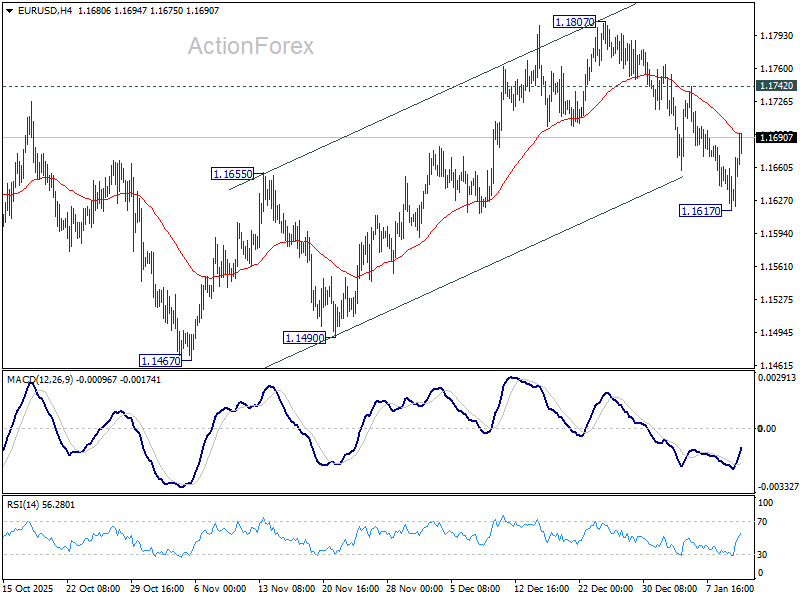
The expectation in the last quarter was there would be a rally to 1.4580 followed by a top and a subsequent reversal. Looking at the technical data, there may be good reason to look at 1.4309 as the most likely terminus on the wave iv (part of the 5-wave rally that began at 1.3261) of the larger sequence of 3 waves. The wave v of 3 may just burst through 1.4967 over the next four to six weeks. It is reasonable to target the 1.5364 level — the 61.8 percent follow-through extension from i to iii. There is enough data to support the bullish bias over the short term, as extremes in a bearish sentiment for Euro and a bullish sentiment for USD have been detected. It is possible this rally could continue through towards 1.6000 in keeping with the tendency of currencies to exhibit extensions on the 5th wave and to follow through with a blow-off top. The formation of the pattern is the key aspect in determining when a turn is about to occur (in a rally or a decline). It is important to follow the current pattern.
Managed Forex Accounts – EUR/USD Outlook 2008 (3/3)
•
Tinggalkan Balasan